

The majority of the UK’s largest local news websites have seen a decline in audience and minutes spent with their content in the past year, according to Ipsos iris data.
Among the 75 biggest local news titles in the UK, just 16 grew their audience year on year in April while 15 increased the monthly time spent on their platforms.
The average monthly audience at the 75 local newsbrands analysed fell by 19%, from 2.3 million in April 2025 to 1.5 million.
Average minutes spent fell by 16.4%, from 6.1 million to 4.5 million.
The 75 local newsbrands in Press Gazette’s analysis all appeared in an Ipsos iris dataset of the top 2,100 online brands in the UK in April.
Of 35 titles owned by Reach on the list, 31 saw a decline in engagement. The publisher owns the four worst-hit sites in terms of minutes spent in April 2026.
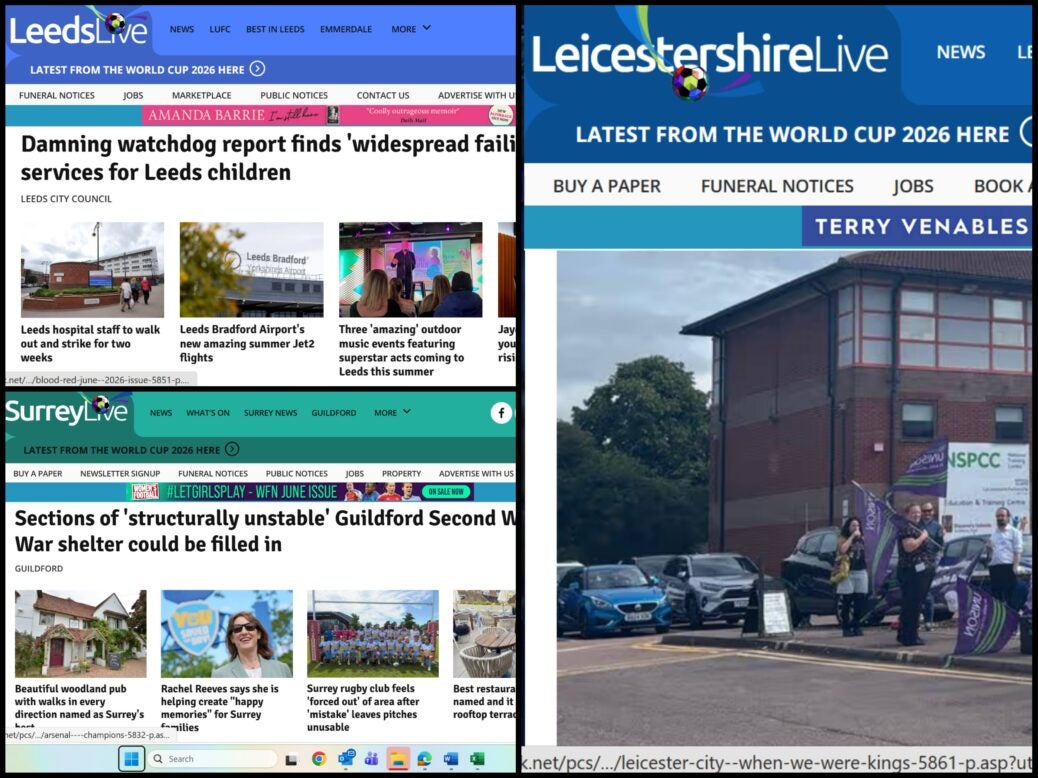
Minutes spent with Surrey Live were down 77.9% to 1.4 million minutes, followed by Leicestershire Live (down 70.3% to 1.7 million minutes), Leeds Live (down 68.8% to 2.1 million minutes) and Lincolnshire Live (down 60.4% to around 651,000 minutes).
Reach also owns 18 of the 20 worst-hit newsbrands for year-on-year audience decline including the 13 with the biggest drops.
Leicestershire Live saw the steepest decline, down 83% to an audience of around 692,000, followed by Leeds Live (down 79.6% to 886,000) and Surrey Live (down 75.7% to 1.2 million).
At the start of 2025 Surrey Live had seen a 320% growth in audience to 4.4 million and 202% growth in total minutes to 5.6 million likely due to success on Google Discover, particularly with health content.
Google Discover referrals have plunged at Reach in the past year as the platform’s algorithm began to prioritise more user-generated content and video.
Reach chief content officer David Higgerson told Press Gazette that despite tech platform “volatility”, Reach has “maintained local audience reach in towns and cities across the UK”, citing 50% audience reach in Manchester for the MEN, 35% reach in Birmingham for Birmingham Live, 41% of people in Wales reading Wales Online and 40% of people in Northern Ireland reading Belfast Live.
Higgerson said: “This data shows more of the same trends we’ve been speaking about this year.
“We as a publisher had particularly benefited more than most others from a Google Discover spike and have seen that drop with Google algorithm changes.
“However for our local titles, much of that audience was from out of area, which is why our local audience remains intact.
“Even in supposed ‘news deserts’ like Gateshead, Chronicle Live reaches 40% of the population, a figure it has reached with local news online steadily for years.”
He continued: “Our own analysis of our local titles shows a 13% decline in readers year on year, but at 27% increase in time spent per visit.
“This reflects a growing focus on live blogs, longer-form stories and also video, and tells us that when people do see our content, they click on it and stick with it for longer.”
Newsquest titles led engagement growth year on year, with York-based The Press more than doubling its monthly minutes to 2.6 million, up 106.1%.
This was followed by the publisher’s Southampton-based Southern Daily Echo, up 84.1% to 6.3 million minutes.
Newsquest says local planning, court, crime and going out are currently among the most popular topics across its newsrooms.
Chief executive Henry Faure Walker told Press Gazette in September that Newsquest brands were seeing success through engaging audience with stories grounded in “local context”, assessing audience analytics, and offering subscribers puzzles and rewards.
Just one of the 16 local newsbrands to see growth in the UK across the 75 titles was owned by Reach: Glasgow Live, which was up 11.8% to 1.4 million.
Most (11) of the newsbrands that grew their audience were owned by Newsquest, with the Gazette and Herald growing its audience up 225.5% year on year and 194.7% month on month to reach around 640,000 people.
Newsquest’s Dorset Echo (1.5 million), Herald Scotland (2.9 million) and Oxford Mail (2.7 million) also saw big year-on-year gains in audience, up 153.9%, 92.8% and 87.8% respectively.
Other notable risers include Iconic Media’s Peterborough Telegraph, up 19.6% year on year to a reach of 447,000. The brand also saw the second-biggest month-on-month growth, up 50.9%.
In terms of monthly reach, Reach’s Manchester Evening News remained the biggest title for audience (down 24.1% year on year to 8.9 million) and minutes (down 5.9% to 57.1 million).
The Standard in London (formerly The Evening Standard) remains the second-largest local newsbrand despite a drop in audience of 32.9% in a year to eight million in April. The digital brand transferred ownership to Independent Media earlier this year, resulting in staff redundancies. Minutes spent with the brand dropped by 43.7% to 31.2 million.
Among the 75 titles analysed, 35 are published by Reach, 22 by Newsquest, and 13 by Iconic Media (formerly National World sites).
All three publishers saw decreases in their audiences and minutes spent year on year, although these figures include Reach’s national brands: the Daily Mirror, Daily Express and Daily Star as well as magazine brand OK!.
Newsquest recorded the lowest proportional decrease in monthly minutes across its platforms (77.5 million, down 0.3%) of the three publishers, while Reach’s monthly audience fell the least, down 4.6% to around 34 million people.
Ipsos iris replaced Comscore as the news industry-recognised standard data provider in 2021. Ipsos iris data is partly derived from a panel of 10,000 people aged 15 and over that is designed to be nationally representative. The participants have meters installed across 25,000 personal devices to passively measure website and app usage.
This data is combined with data from participating websites which are tagged so all devices visiting the site can be identified and logged.
As of January 2022, Ipsos increased the sources of embedded browser traffic (web content viewed within a mobile app) counted in its data. Its monthly data now includes webpages consumed within other mobile app embedded browsers such as Linkedin, Twitter, Google News and Instagram, as well as Facebook which has been counted in its data since 2021.
Email pged@pressgazette.co.uk to point out mistakes, provide story tips or send in a letter for publication on our "Letters Page" blog
